Contextual framing, AI readiness, and foundational literacy
Define what the proposed AI would do, use, and not do, and who should be involved.
Outputs: AI System Flow Map, Scenario Cards, Readiness and Fairness Audit
Participatory AI Literacy and Explainability Integration: a six-stage framework for designing resident-facing AI tools before the model is finalized, with a documented artifact at every stage.
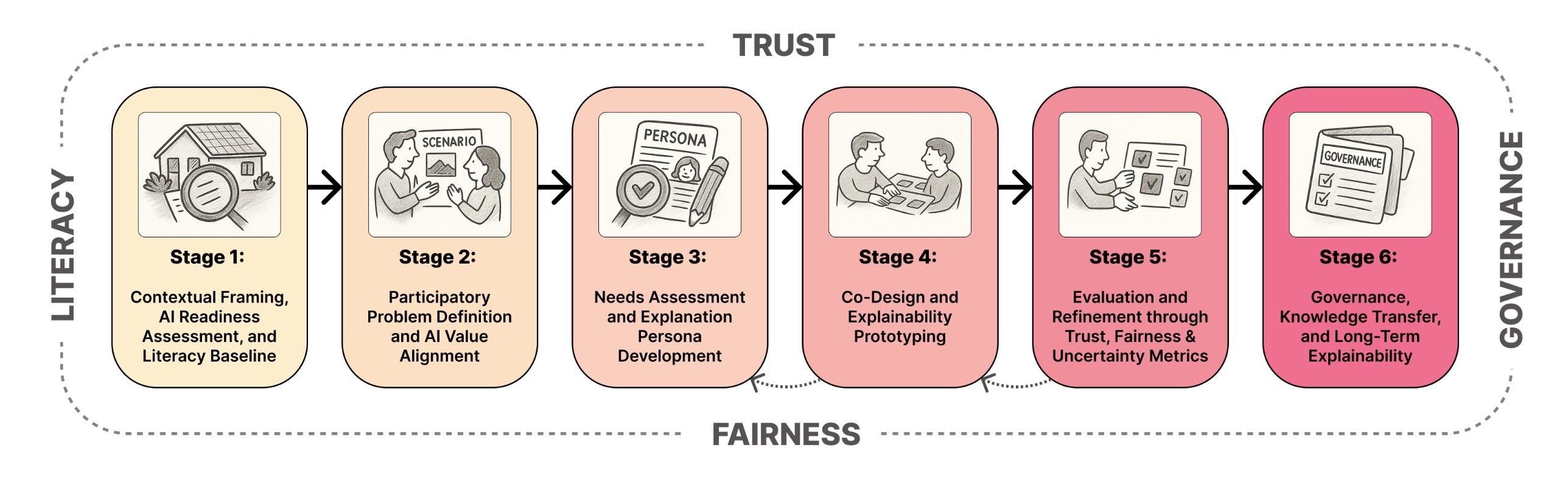
PALEI builds on participatory design, explainable AI, AI literacy, and human–AI interaction. Its contribution is how these are integrated and operationalized: community evidence becomes AI design requirements, competing explanation strategies, and evaluation and governance criteria, each documented as an artifact.
Residents help define what the tool should explain before the model and key technical decisions are fixed.
Every stage considers what residents must understand about outputs, uncertainty, limits, and data practices.
Findings become documented requirements, design choices, and evaluation criteria you can trace back.
Define what the proposed AI would do, use, and not do, and who should be involved.
Outputs: AI System Flow Map, Scenario Cards, Readiness and Fairness Audit
Residents discuss the problem and the AI itself: trust, privacy, fairness, how results should be shown.
Output: AI Value Map, turning input into design requirements before any model exists
Translate requirements into explanation needs, including where people may misread a result.
Outputs: Explanation Personas and seven shared design principles
Residents compare alternative explanation designs of the same result; short tasks check interpretation.
Outputs: Bias and Fairness Monitoring Log, screen-level Findings Matrix
Test one combined, clickable prototype for correct interpretation, uncertainty, reliance, fairness, and usability.
Outputs: task-based usability and interpretation results
Responsibilities, uncertainty over time, data rules, and onboarding so explanations stay accurate after handoff.
Outputs: handoff plan, uncertainty guide, bias and coverage checklist
AI literacy here means what residents need to understand about a specific AI tool to use it appropriately: what it does, how to read results, uncertainty and limits, when professional judgment is needed, and their data rights (adapted from Long and Magerko, 2020).
This is what a product team gains from PALEI: every requirement has a visible trail back to the people who raised it, and forward to how it will be checked.
The System Flow Map shows what images the tool would use and what it would not collect.
Privacy or data security was the top concern (64.3%); residents worried about insurer access.
Value Map dimension “Privacy Boundaries” → principle: show data practices before any upload.
A Data & Privacy screen appears before media submission and is shown to every co-design participant.
Evaluation criterion: can residents correctly say who sees their images and when they are deleted?
Data-retention and sharing policy: no insurer sharing by default, documented for whoever deploys the tool.
The smart transit case helped establish the broader AI integration problem. The wildfire case is the primary application of the revised framework, from AI literacy at a town hall to co-design and usability testing.
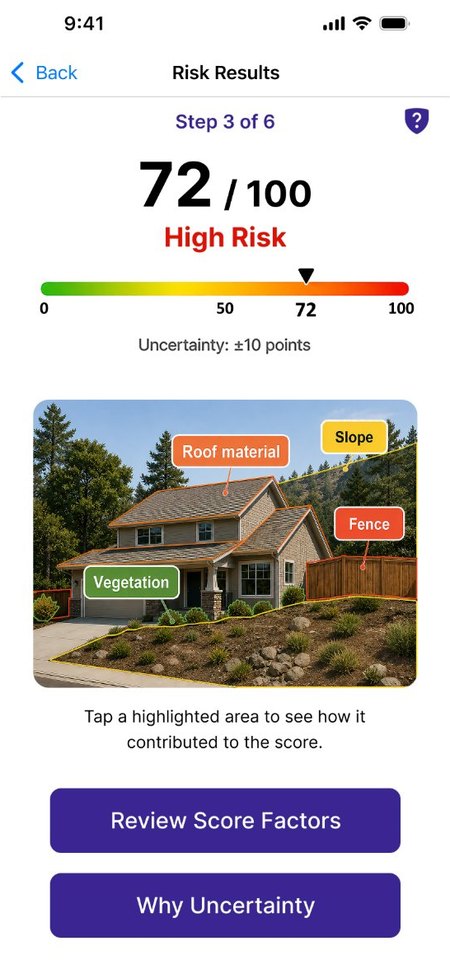
Primary application: town hall, survey, AI Value Map, personas, 24 co-design sessions, usability testing next.
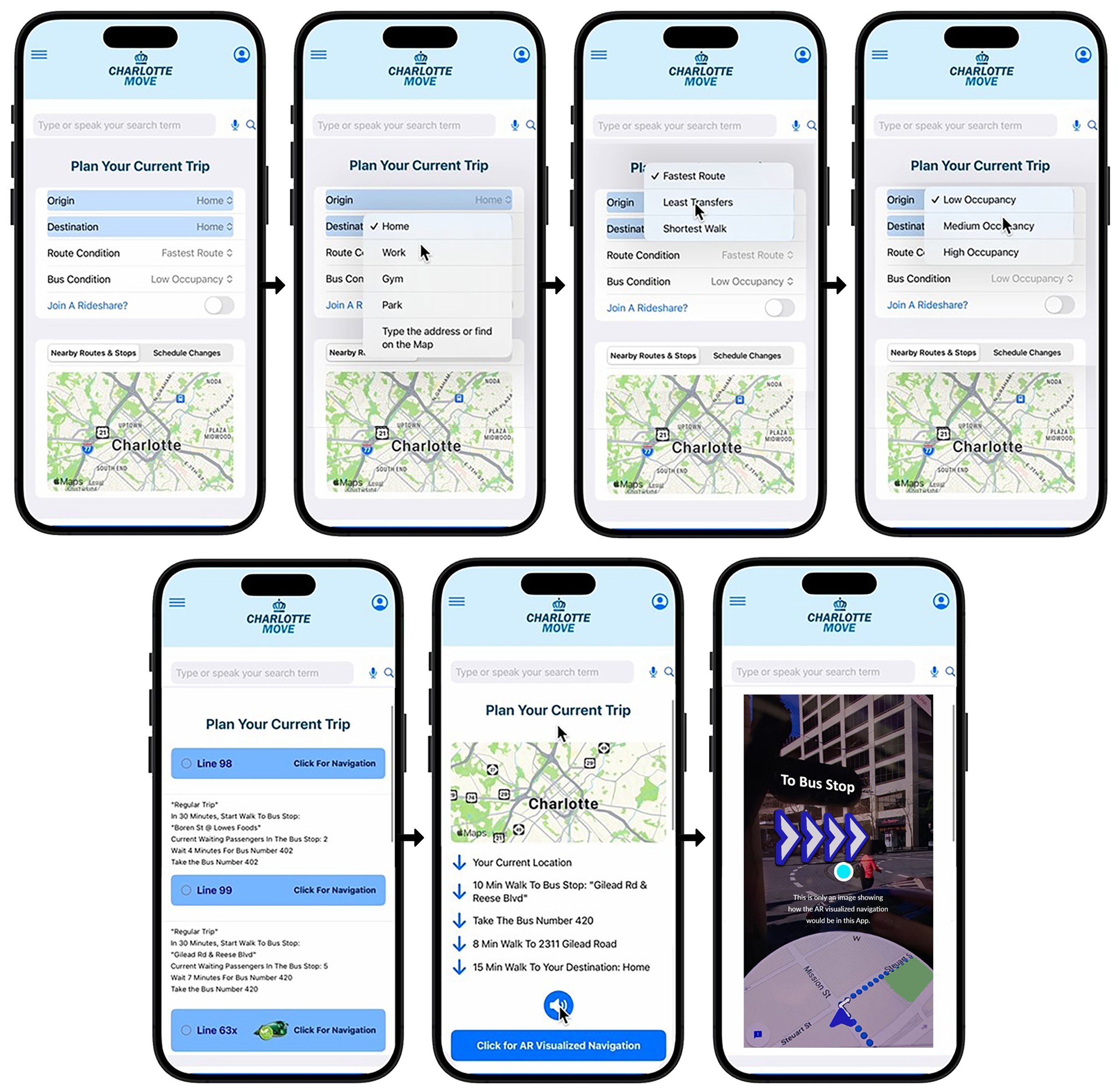
Established the AI integration problem: 160-rider survey, equity modeling, prototype testing.
Teams learn what users need explained while it's still cheap to change the model and the interface.
The AI Value Map and Findings Matrix link each requirement to the participant evidence behind it.
A bias log runs during prototyping, not as an audit after release.
Built for wildfire risk and transit; designed to transfer to health, finance, and civic AI.